A public collection of diagrams, infographics, and commentary graphics created to make execution-control problems easier to understand, discuss, and share.
These visuals communicate high-level ideas. They are not implementation specifications, complete component definitions, validated performance benchmarks, or substitutes for the current Architecture Directory.
Architecture orientationRisk illustrationsCybersecurityPathway selectionRobotics and physical actionWearable AI and privacy
SafeWave visuals are created for different purposes, including general orientation, X posts, presentations, public commentary, risk explanation, and strategic discussion. Some use simplified descriptions so a complex systems problem can be communicated clearly in one image.
Where a visual names a SafeWave component, the Architecture Directory remains the authoritative source for the component’s current canonical definition. Percentage ranges and scenario outcomes shown in illustrative graphics are not validated benchmarks unless expressly identified as measured results.
Architecture and overview
High-level introductions to SafeWave execution control
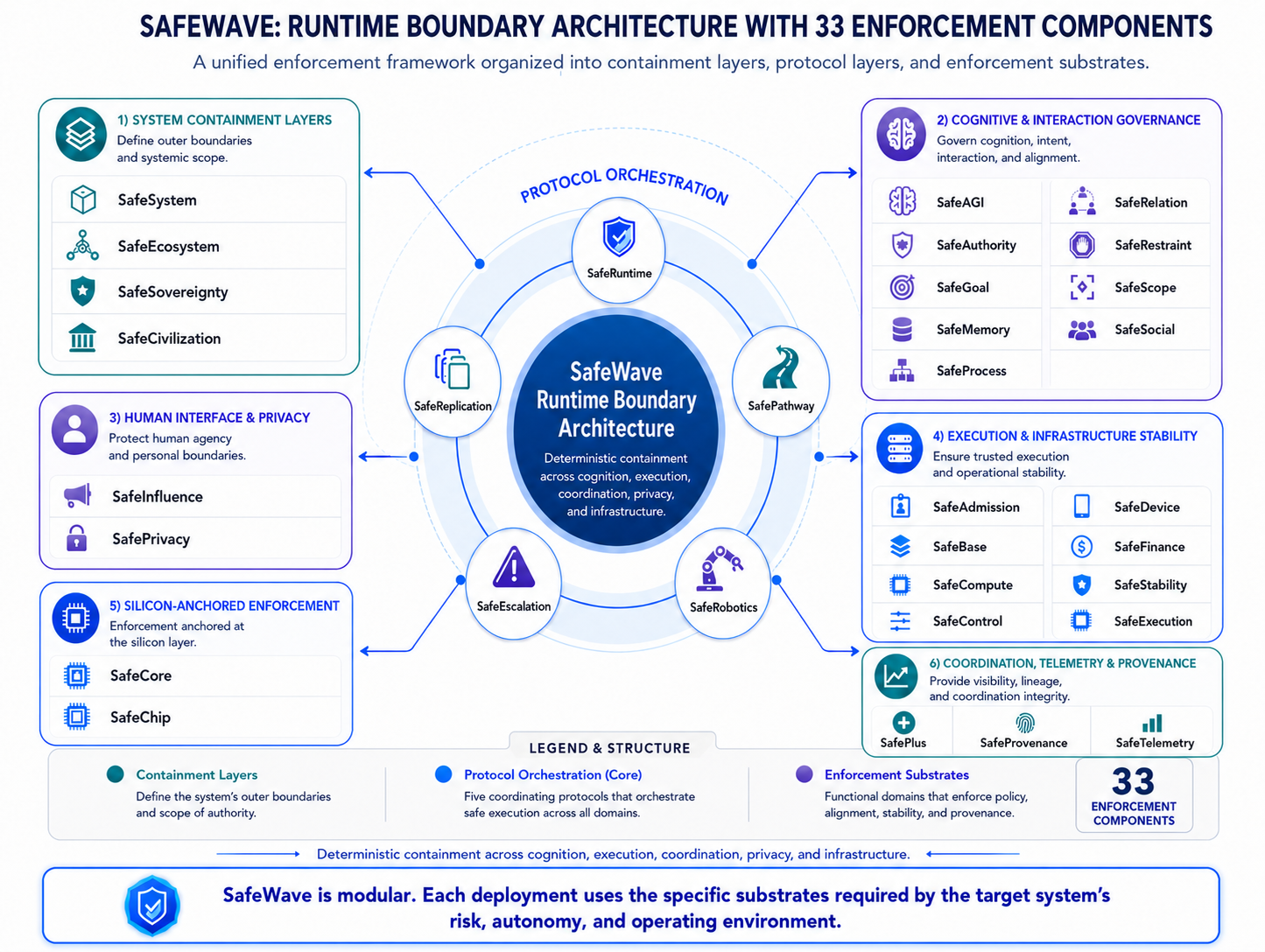
These visuals present simplified public explanations of SafeWave’s purpose and operating logic. They are intended to orient the viewer rather than reproduce the full 36-component architecture or assign every control function to a single layer.
General overview visual
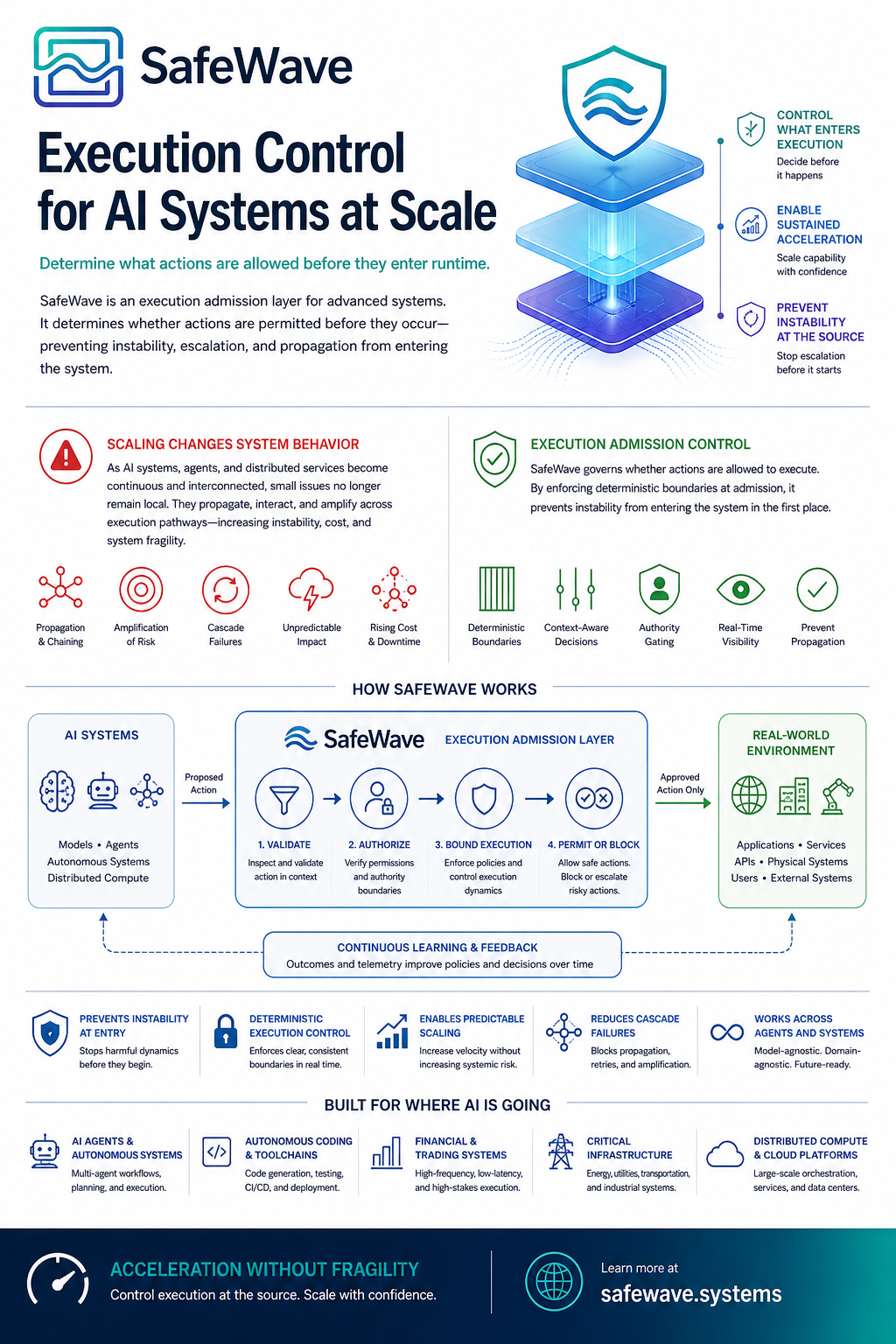
SafeWave Overview
A broad public infographic describing why AI execution requires deterministic boundaries as systems, agents, services, tools, and infrastructure become more continuous and interconnected.
This image uses a simplified admission-oriented flow to explain the general concept. SafeWave’s complete architecture also addresses controls during operation, degradation, escalation, intervention, recovery, and re-entry.
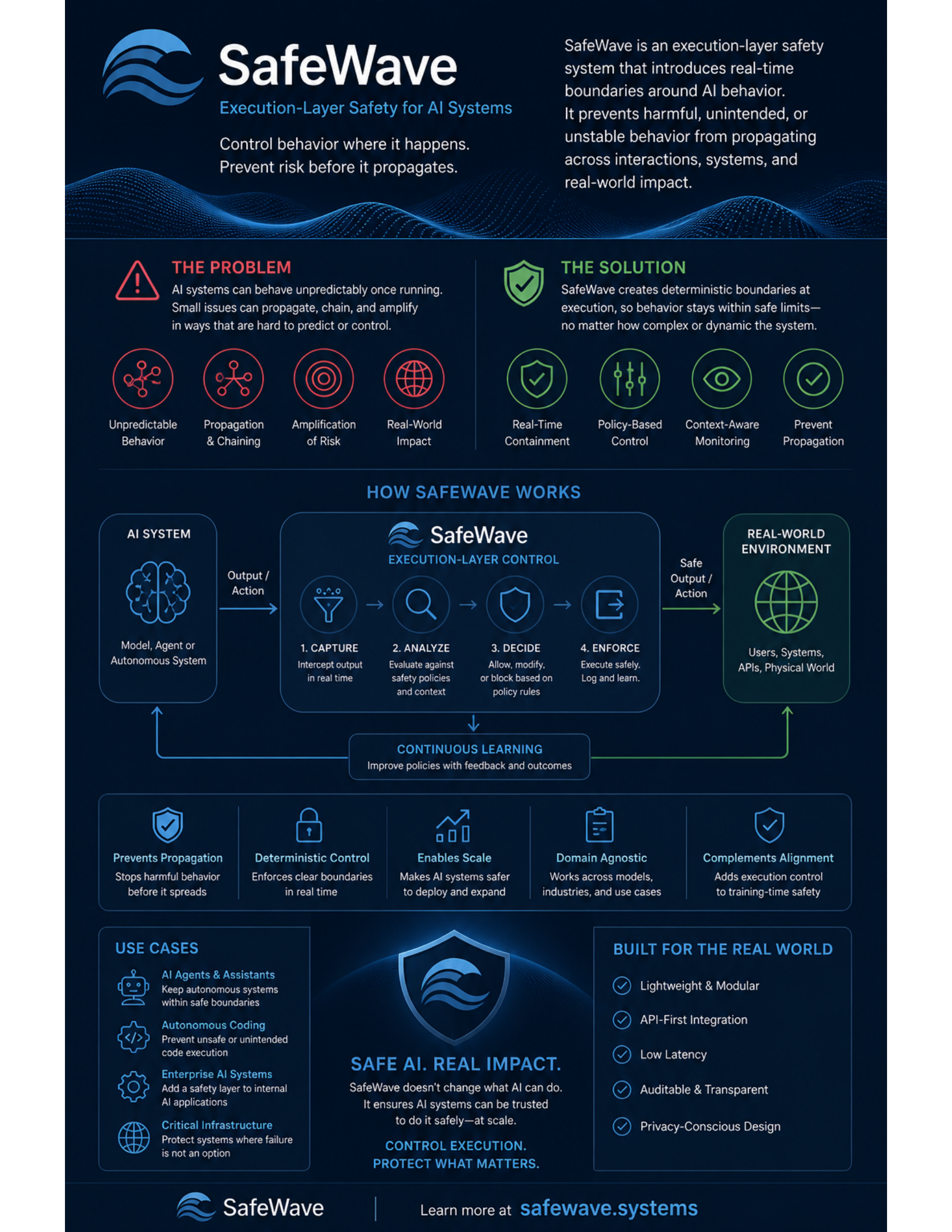
An earlier public explanation of execution-layer control, propagation risk, real-time enforcement, and the distinction between model capability and permitted real-world action.
This is a simplified outreach graphic rather than a current architecture map. The Architecture Directory contains the authoritative component structure and definitions.
What remains executable after an environment is breached?
Cybersecurity aims to prevent, detect, contain, and recover from intrusion. SafeWave adds a related execution-control question: after compromise, what actions, workflows, tools, identities, connected systems, and external effects remain available?
Cybersecurity risk visual
After the Breach: What Can Still Execute?
A public graphic examining the difference between keeping attackers out and bounding what a compromised AI-enabled system may still be able to execute.
The image frames a control question rather than claiming that one control can prevent every post-breach consequence.
Illustrative pathway, resource, and execution-demand graphics
SafePathway evaluates candidate model, provider, tool, hosting, and execution pathways under supplied constraints. Public graphics may also show adjacent execution-control concerns to explain the wider operational context.
Illustrative scenario framework
SafePathway and Avoidable Execution Demand
A discussion graphic showing how task-sufficient pathway selection may reduce avoidable use of oversized models, unnecessary remote execution, excessive tool chains, or other high-resource execution choices.
The 5–35% ranges are illustrative, not validated SafeWave performance benchmarks. Actual savings may be lower, higher, or absent depending on workload mix, baseline efficiency, deployment design, orchestration, and implementation.
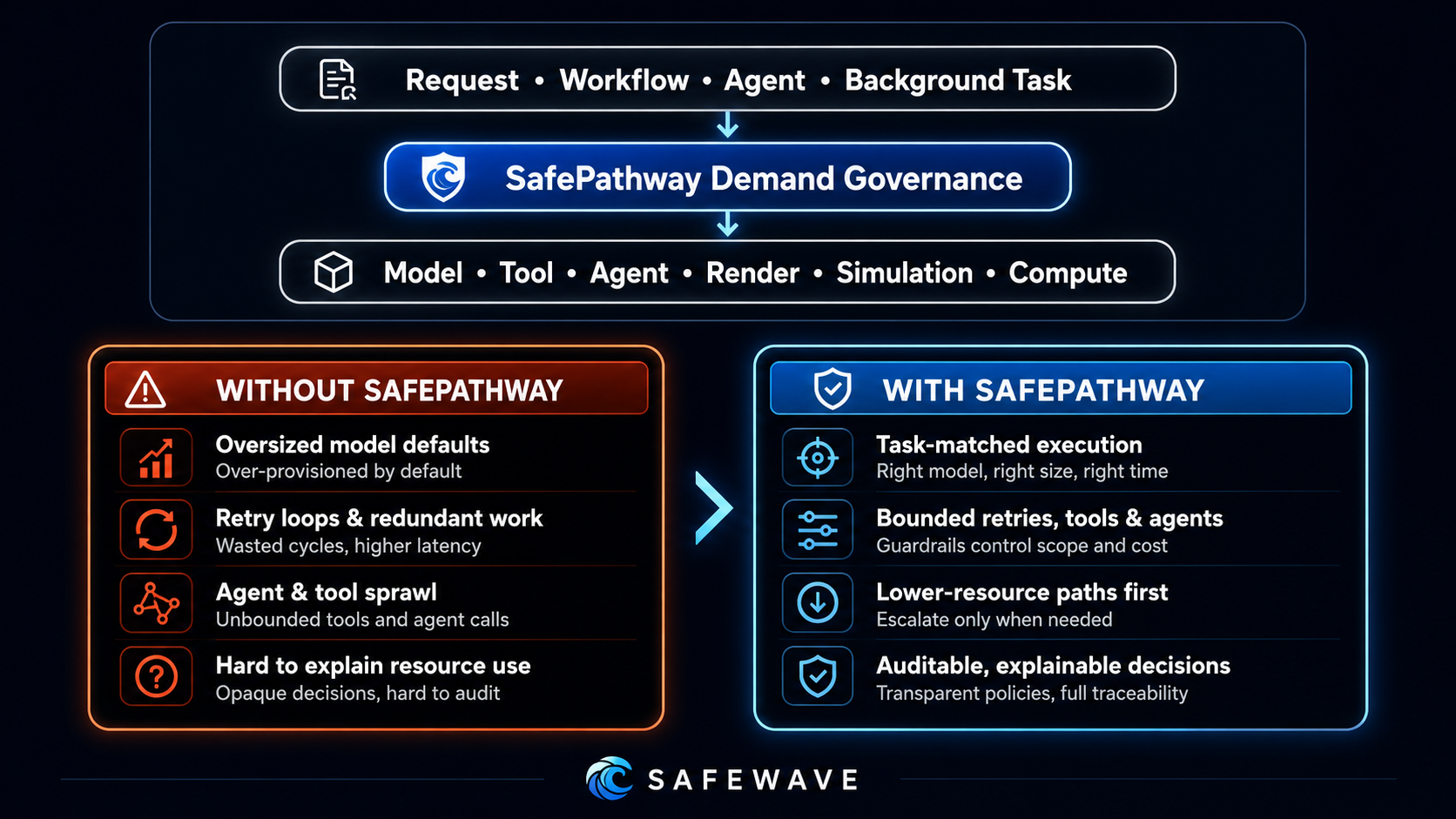
A high-level comparison between weakly governed execution-path choices and a more deliberate pathway-selection process using task fit, approved constraints, resource awareness, and traceable decisions.
The visual combines SafePathway with adjacent controls for public explanation. The Architecture Directory and engineering materials govern the exact component boundaries.
When AI interpretation can affect physical action or private space
These visuals illustrate how AI-generated instructions, persistent sensing, remote services, memory, inference, and connected tools can create new control questions at the boundary between digital interpretation and real-world consequences.
Robotics outreach visual
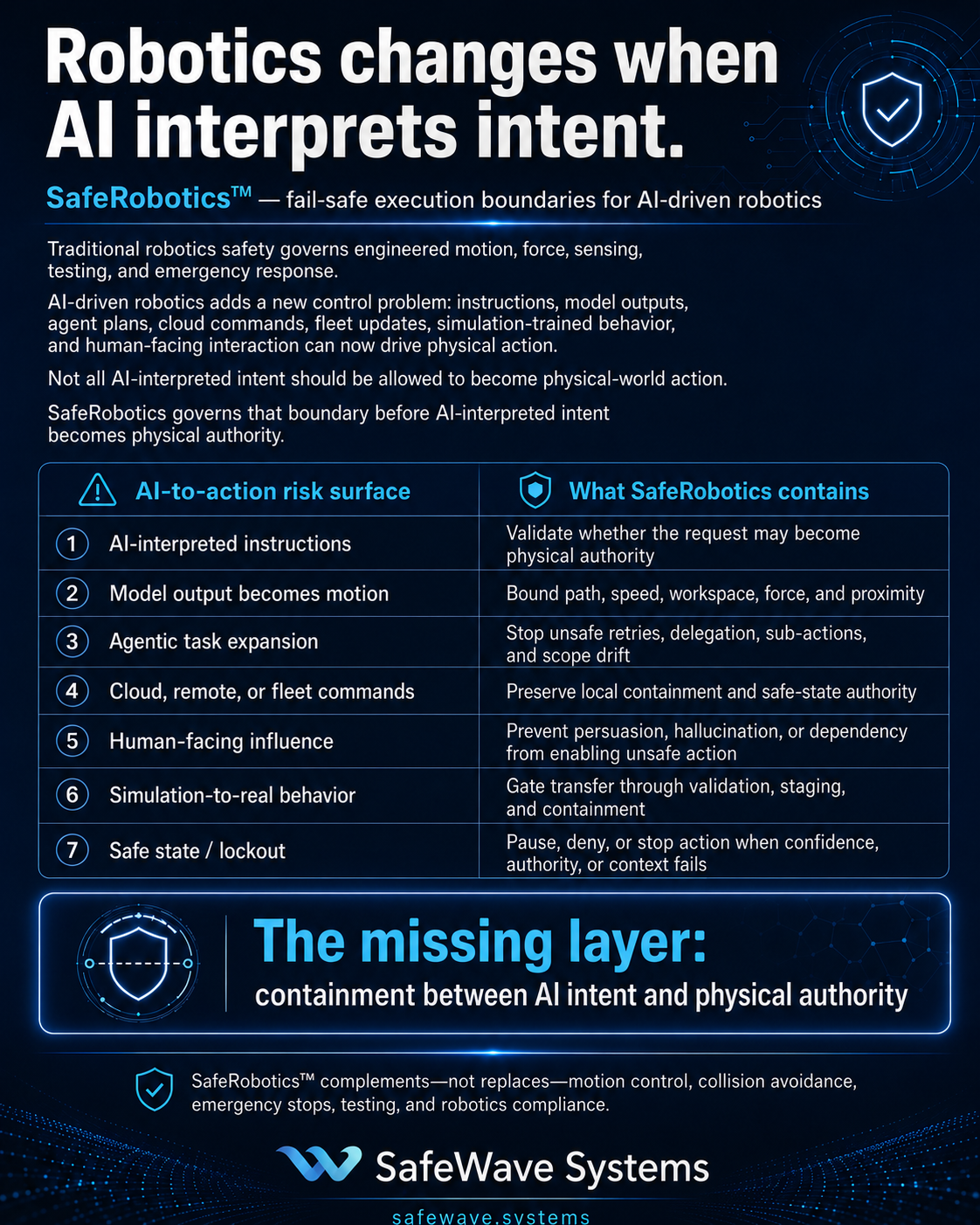
SafeRobotics Physical Authority
A public graphic explaining why AI-driven robotics requires controls between generated or interpreted intent and permitted physical action.
The visual summarizes a broad robotics risk surface. Exact mappings among SafeRobotics and other SafeWave controls depend on the deployment and the canonical definitions.
A public-risk graphic showing that wearable AI may capture not only what the wearer intentionally observes, but also bystanders, screens, documents, conversations, identity signals, location, personal information, and contextual details.
This is a general wearable-AI risk illustration. It does not assign the full problem to one SafeWave component or claim that every device uses every data pathway shown.
Visuals created for broader explanation and timely public discussion
Some SafeWave graphics are designed to communicate a strategic point quickly in a public post or presentation. These may use compressed terminology and should not be treated as formal engineering diagrams.
SafeWave purpose asset
SafeWave Purpose Banner
A broad public banner communicating SafeWave’s purpose: helping advanced AI and AI-enabled systems operate within engineered boundaries while preserving beneficial capability.
This is a public positioning asset rather than a technical architecture specification.
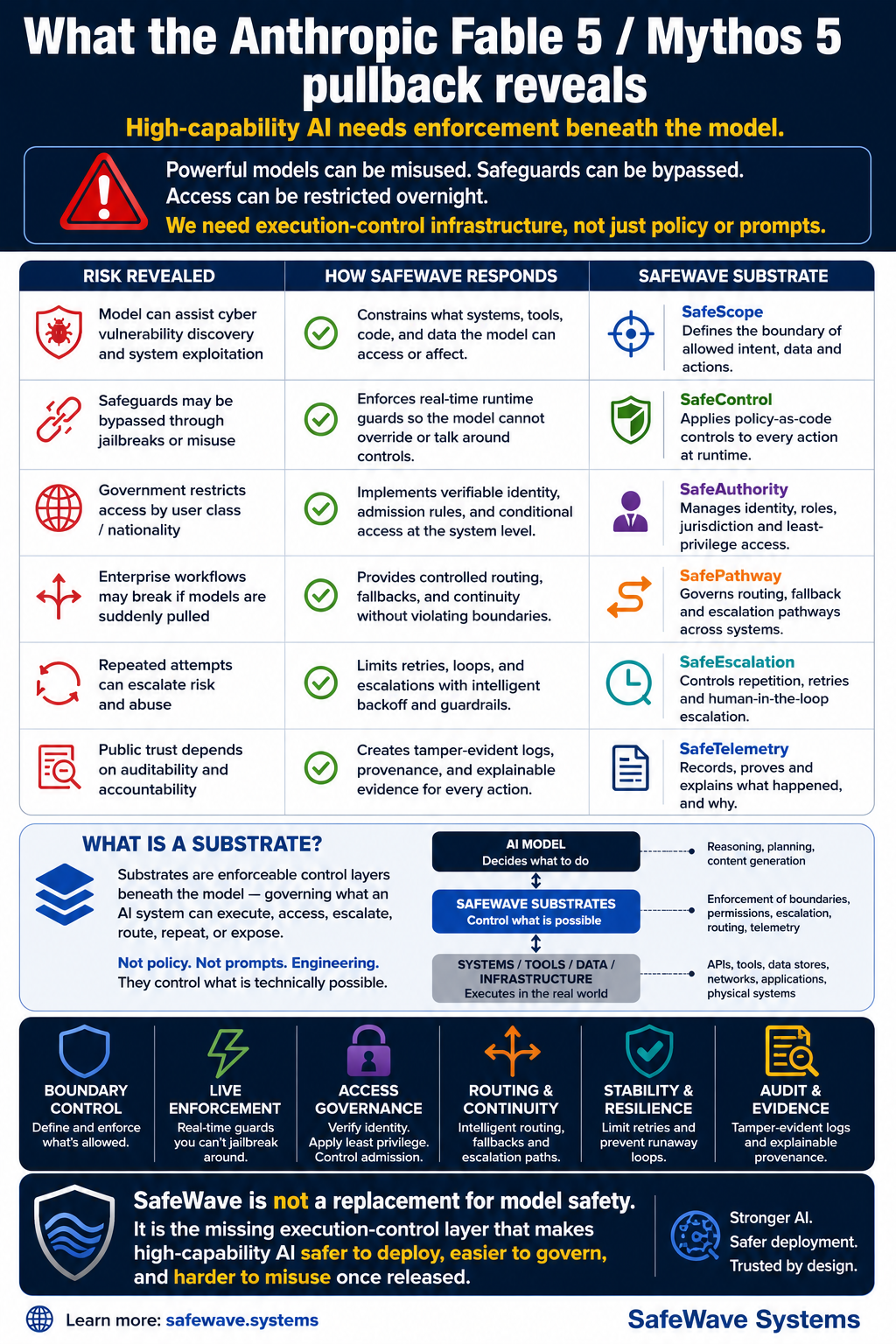
A public-commentary graphic created to explain what a specific model-access development suggested about execution control beneath the model, including boundary control, live enforcement, access governance, pathway continuity, escalation, and evidence.
This graphic uses simplified component descriptions prepared for a specific public development. SafePathway and SafeEscalation are Protocol Enforcement Layers, while other named items in the visual are Core Enforcement Substrates. The Architecture Directory contains the current canonical definitions.