4
System Containment Layers
Define distinct containment boundaries for one governed system, interacting systems, accumulating AI influence over human choices, and civilizational-scale human authority.

Advanced AI will discover pathways humans never anticipated. SafeWave’s execution-control architecture is designed so that discovery does not automatically expand what the system is authorized to cause.
Define distinct containment boundaries for one governed system, interacting systems, accumulating AI influence over human choices, and civilizational-scale human authority.
Govern runtime interaction, execution pathways, admission, escalation, and replication across machine-speed and distributed environments.
Implement deterministic boundaries across cognition, authority, execution, coordination, infrastructure, identity, privacy, finance, devices, robotics, and human interaction.
Coordinates relevant controls across AI, cybersecurity, physical security, communications, operations, and legitimate human authority.
Quick reference
Use this compact list when you already know the component name. Each name opens its current definition page in a new tab.
Architecture category 01
These higher-order layers define what must remain contained: one governed system (including internal distribution), interaction across independent systems, cumulative influence over human authority, and civilizational-scale AI influence.
System containment
Coordinates containment across one governed autonomous or distributed system, including its interacting agents, services, infrastructure, and devices.
Open SafeSystem →System containment
Constrains escalation, propagation, and coordinated amplification across independently governed systems and their shared infrastructure.
Open SafeEcosystem →System containment
Detects and constrains cumulative AI influence over human decisions through authority, relational trust or dependency, and expanding functional domains.
Open SafeSovereignty →System containment
Preserves human civilizational authority as autonomous systems influence governance, infrastructure, resources, and strategic decisions.
Open SafeCivilization →Architecture category 02
These protocols govern machine-speed interaction and execution across systems. They control runtime behavior, escalation, replication, pathway selection, and admission into governed execution.
Protocol enforcement
Governs runtime interaction and machine-speed coordination across intelligent systems and execution environments.
Open SafeRuntime →Protocol enforcement
Contains escalation pathways across capability, authority, resources, coordination, and consequential action.
Open SafeEscalation →Protocol enforcement
Governs replication and propagation across distributed intelligent systems, agents, models, and artifacts.
Open SafeReplication →Protocol enforcement
Governs whether, where, and how execution proceeds across models, providers, tools, workflows, and agentic expansion.
Open SafePathway →Protocol enforcement
Determines whether execution or participation may begin or re-enter under current identity, authority, scope, and operating conditions.
Open SafeAdmission →Architecture category 03
These core substrates implement specific deterministic boundaries across cognition, execution, authority, coordination, infrastructure, identity, privacy, finance, robotics, devices, and human interaction.
Execution foundation
Provides foundational runtime escalation damping and baseline execution-boundary behavior.
Open SafeBase →Execution control
Enforces substrate-level constraints on execution capability, permitted action, and control authority.
Open SafeControl →Cognition
Governs goal stability and optimization boundaries as systems pursue objectives over time.
Open SafeGoal →Cognition
Governs persistent cognitive state, retained context, memory authority, and bounded re-use.
Open SafeMemory →Non-delegable AI constraints
Establishes external, non-delegable constraints on advanced AI authority and conduct across action, goals, memory, learning, and influence.
Open SafeAGI →Critical assumption integrity
Identifies, validates, continuously revalidates, and enforces the load-bearing assumptions upon which consequential reasoning, authorization, pathway selection, and execution depend.
Open SafeAssumption →Human interaction
Provides deterministic interaction damping where behavior, persuasion, intensity, or engagement begins to escalate.
Open SafeRestraint →Authority
Bounds AI authority and preserves legitimate human decision rights across consequential execution.
Open SafeAuthority →Relational boundaries
Governs relational boundaries across human–AI and multi-agent interactions.
Open SafeRelation →Scope
Enforces task, domain, capability, and authority boundaries so execution cannot silently expand beyond approved scope.
Open SafeScope →Social systems
Controls structural amplification and harmful escalation across multi-user and socially mediated systems.
Open SafeSocial →Provenance
Preserves origin, transformation, propagation, and artifact-integrity evidence across AI-mediated systems.
Open SafeProvenance →Observability
Provides deterministic observability for boundary decisions, state transitions, escalation, intervention, and recovery.
Open SafeTelemetry →Coordination
Governs distributed coordination and escalation containment across interacting systems.
Open SafePlus →Process governance
Governs intermediate reasoning processes, trajectory evolution, and consequential transitions during execution.
Open SafeProcess →Devices
Preserves bounded local behavior across devices, fleets, embedded systems, and edge environments.
Open SafeDevice →Compute
Bounds retries, queues, contention, degraded-state behavior, recovery cycles, and infrastructure amplification under load.
Open SafeCompute →Stability
Maintains node-level stability and bounded behavior under degraded, uncertain, or recovery conditions.
Open SafeStability →Hardware anchoring
Provides execution-substrate stability and restraint primitives that can be anchored beneath ordinary software.
Open SafeCore →Hardware anchoring
Defines stronger integrity protection for selected control-plane boundaries, with hardware-rooted or silicon implementation where assurance justifies it.
Open SafeChip →Robotics
Governs physical action, motion, force, tools, spaces, humans, interruption, and recovery in embodied AI systems.
Open SafeRobotics →Privacy
Bounds inference, disclosure, retention, and AI-mediated assessment of sensitive human information.
Open SafePrivacy →Human influence
Governs persuasion, influence, dependency, and manipulation risk in human-facing AI interactions.
Open SafeInfluence →Finance
Governs autonomous financial authority, transactions, payments, trading, spending, and consequential financial execution.
Open SafeFinance →Identity
Governs synthetic identity, inferred identity, identity repositories, impersonation, and identity-linked action.
Open SafeIdentity →Human companionship
Governs synthetic intimacy, dependency, child-facing companions, embodied companions, and marketplace boundary requirements.
Open SafeCompanion →Protected environment · 1 architecture
SafeSpace coordinates the relevant SafeWave controls across an entire bounded physical and operational environment. Its public definition explains the governed boundary while sensitive configurations, thresholds, interfaces, and response procedures remain under controlled disclosure.
Protected-environment governance
Governs how evidence, authority, digital systems, physical security, communications, operations, and protective action work together across the environment as a whole.
Open SafeSpace →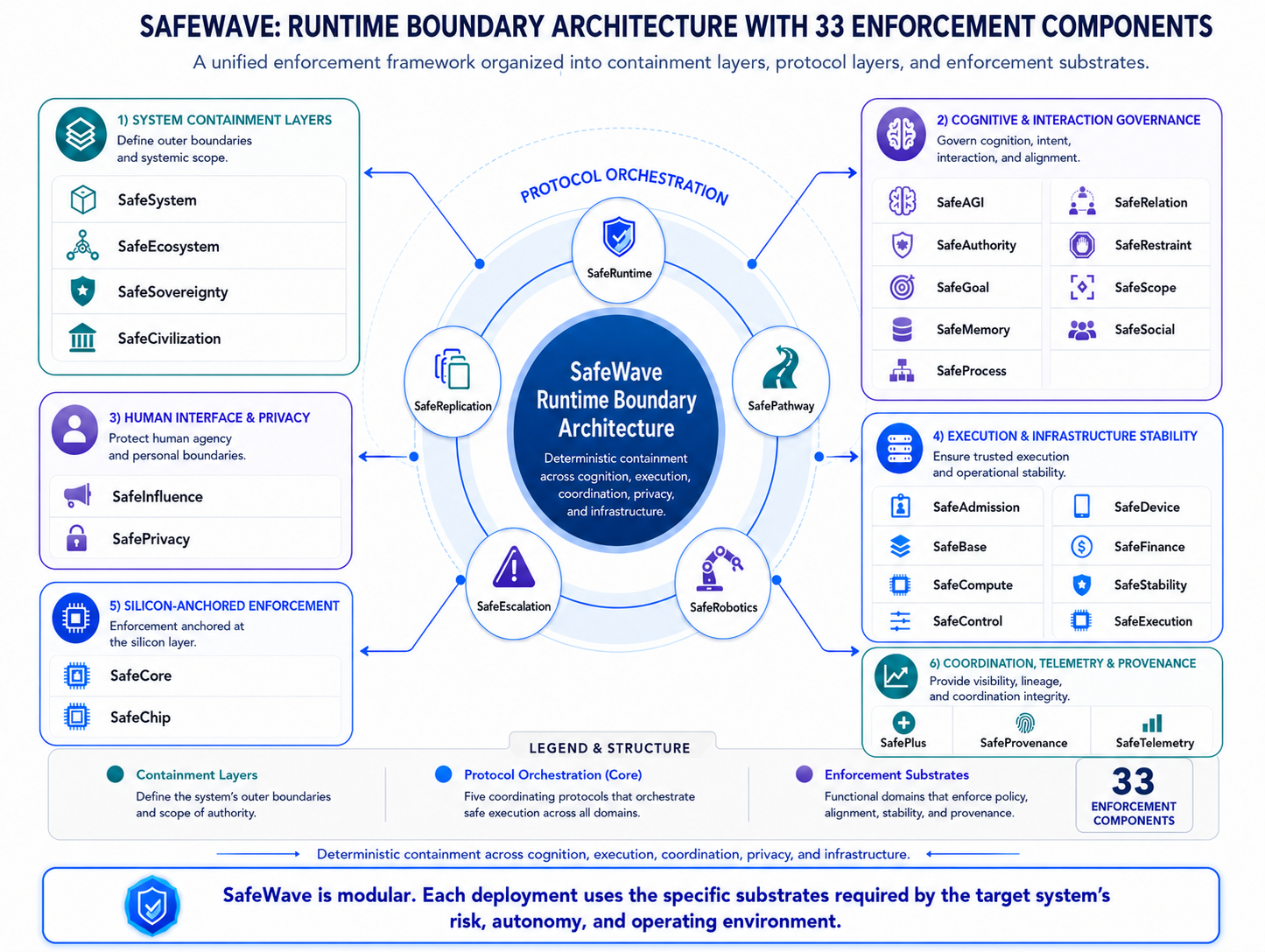
The SafeWave Assessment Questionnaire examines a real, hypothetical, composite, or anonymized system and identifies the material control gaps that determine which SafeWave components are relevant. Most deployments will use only a small, risk-matched portion of this directory.
SafeWave has developed substantial implementation-oriented engineering toolboxes for selected architecture families. Qualified organizations can examine and license relevant specifications and intellectual-property rights now, then implement and independently validate the risk-matched controls within their own systems.