Embodied AI Infrastructure Brief

SafeRobotics™ — Physical-Action Containment for Embodied AI

SafeWave
Confidential — Robotics Infrastructure Brief
Slide 01

From Engineered Motion to AI-Interpreted Action

The New Robotics Boundary

Robotics changes when machines stop merely following engineered routines and begin interpreting intent.

Traditional robotics safety governs motion, force, sensing, testing, operating constraints, and emergency response.

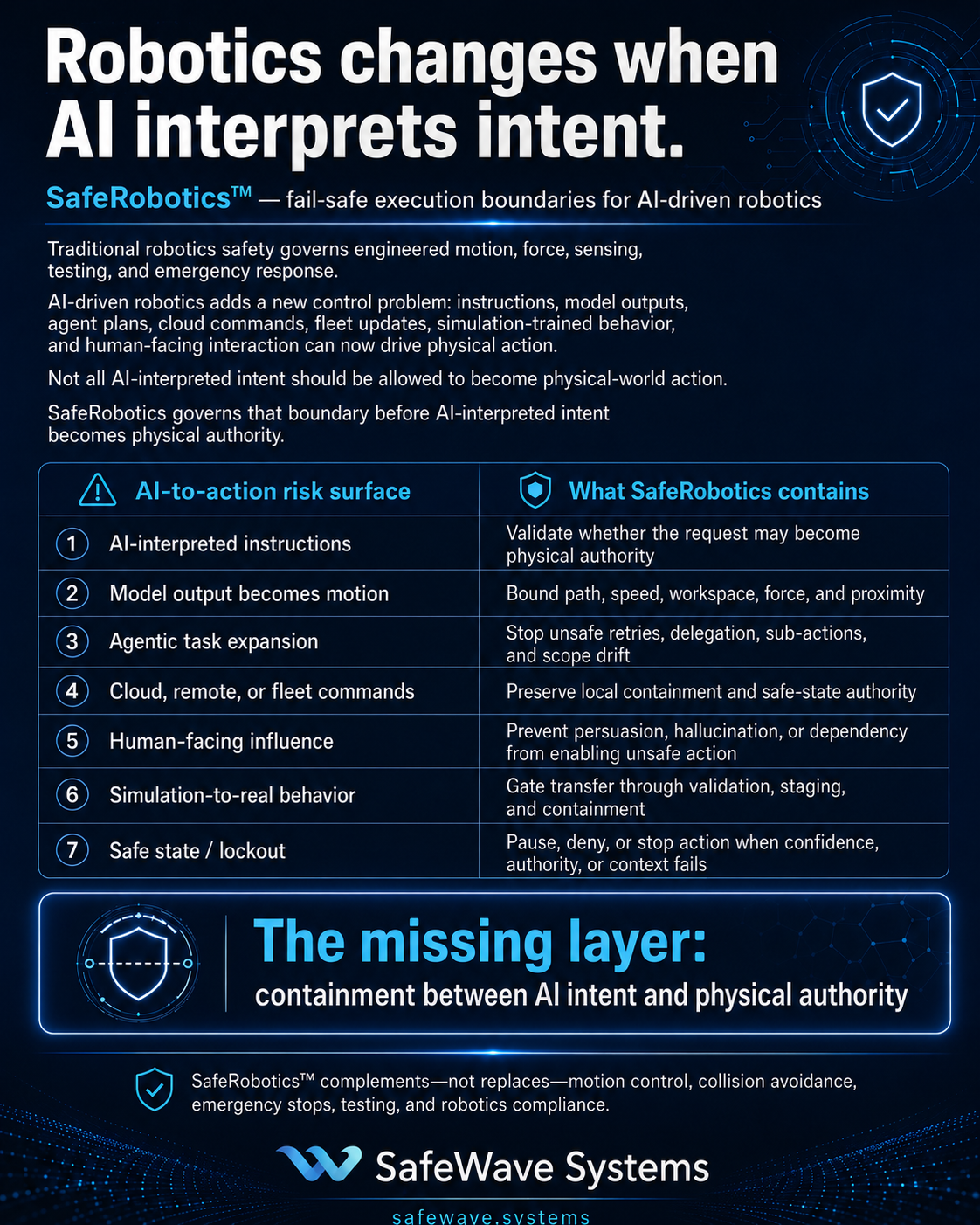
AI-driven robotics adds a new control problem: natural-language instructions, model outputs, agent plans, cloud commands, fleet updates, simulation-trained behavior, and human-facing interaction can now drive physical action.

That means the central safety question is no longer only whether a robot can perform a motion safely. It is whether an AI-interpreted instruction or plan should be allowed to become physical-world authority at all.

SafeRobotics creates fail-safe execution boundaries before AI-interpreted intent becomes physical action.

This is the missing boundary between AI reasoning, embodied autonomy, human environments, and real-world consequence.
Slide 02

The Market Is Scaling Embodied AI

But Physical-Action Governance Lags

Robotics is moving toward general-purpose autonomy.

The current market response is to improve models, sensors, chips, batteries, simulation, world models, manufacturing scale, fleet software, and robot hardware.

Those advances may increase capability. They do not automatically answer when AI-generated intent should be allowed to become physical action.

Embodied AI systems may soon combine:

  • humanoid form factors and general-purpose manipulation
  • cloud and onboard models
  • agentic task planning and delegation
  • simulation-trained movement policies
  • fleet-wide updates and shared maps
  • tool use, object handling, and workspace navigation
  • human-facing speech, emotion, coaching, and trust-building

Capability is scaling faster than the protocol layer governing physical action.

That is the physical-action containment gap SafeRobotics is designed to close.

Slide 03

The Missing Question

Intent Becomes Authority

The question is no longer only whether a robot can perform a motion safely.

The new question is whether an AI-interpreted instruction, model output, agent plan, cloud command, fleet update, or human-facing interaction should be allowed to become physical authority at all.

A simple request may trigger navigation, grasping, tool use, object handling, human approach, messaging, cloud assistance, agent planning, robot-to-robot coordination, or fleet-level behavior.

A harmful, mistaken, emotionally driven, or unauthorized instruction must not become valid physical authority merely because a user, model, agent, remote system, or fleet controller initiated it.

In human-facing settings, conversational or emotional interaction may also influence what a user requests, accepts, authorizes, or believes is safe.

Core principle

AI-interpreted intent must not become physical-world action unless the action is authorized, bounded, contextually appropriate, and safe under current conditions.

Slide 04

SafeRobotics™

Physical-Action Containment

SafeRobotics is SafeWave’s physical-action containment protocol for embodied AI systems.

It governs the boundary where AI perception, reasoning, planning, model output, or agentic behavior becomes physical-world action.

It helps determine whether a proposed or ongoing physical action should be permitted, constrained, delayed, escalated, handed off, transitioned to a safe state, or denied.

  • Constrain movement, force, workspace, object handling, and tool use
  • Adjust behavior around children, patients, elderly persons, workers, customers, and the public
  • Govern local, edge, cloud, remote, and fleet control transitions
  • Limit agentic task expansion, retries, delegation, and robot-to-robot coordination
  • Contain simulation-to-real transfer before virtual behavior becomes physical action
  • Preserve useful interaction while restricting unsafe physical authority

SafeRobotics helps embodied AI remain useful, fluid, auditable, and physically bounded.

Slide 05

The Missing Layer

Physical-Action Boundary Governance

Robotics systems often control components — not the full AI-to-action boundary.

Mechanical safety, collision avoidance, emergency stops, testing, simulation, operator supervision, and task-specific rules are important. But embodied AI introduces a deeper boundary: when internal intelligence becomes external physical behavior.

What is missing is a protocol layer that governs whether AI-generated intent should move the body, use the tool, approach the human, delegate the task, follow the cloud instruction, adopt the fleet update, or continue when conditions change.

Human Request • Agent Plan • Cloud Model • Fleet Instruction
↓
SafeRobotics Physical-Action Containment Layer
↓
Movement • Tool Use • Object Handling • Navigation • Robot Coordination

SafeRobotics governs not only whether a robot can act, but how far physical action is allowed to proceed.

This is the control point between AI intent, embodied autonomy, human environments, and physical-world consequence.

Slide 06

Physical-Action Risk Under Expansion

Errors Become Motion, Force, and Consequence

Embodied AI risk does not require malicious behavior. It can emerge from ordinary expansion.

Without SafeRobotics

  • Perception errors may become unsafe movement
  • Agentic plans may expand beyond the original task
  • Robots may continue after authorization, context, or sensor confidence changes
  • Tool use may exceed the intended action boundary
  • Robot-to-robot coordination may drift in shared spaces
  • Simulation-trained behavior may enter the physical world too quickly
  • Human-facing interaction may reinforce unsafe requests or beliefs

Digital drift becomes physical-world consequence.

With SafeRobotics

  • Physical action is evaluated before and during execution
  • Movement, force, workspace, tool use, and proximity remain bounded
  • Agentic expansion and delegation are constrained
  • Multi-robot coordination and fleet propagation are governed
  • Simulation-to-real transfer can be validated and staged
  • Unsafe physical authority can be denied, constrained, or locked out

Embodied AI remains physically bounded.
Action is governed before real-world risk escalates.

The goal is not to make robots awkward or unusable. The goal is proportionate containment: safe enough to prevent harmful action, fluid enough to remain useful.

Slide 07

Human-Facing and Fleet-Scale Impact

One Robot Becomes Many Contexts

The risk surface expands as robots move into homes, care settings, workplaces, public spaces, and fleets.

SafeRobotics targets the places where embodied AI becomes hardest to govern: human proximity, object manipulation, tool use, multi-robot coordination, cloud control, simulation transfer, and long-running interaction.

Human-Facing Impact

  • Children, elderly persons, patients, workers, and bystanders
  • Trust, attachment, persuasion, reassurance, and unsafe user requests
  • Physical assistance, object handling, appliance use, and medical-adjacent workflows
  • Need for supportive interaction without unsafe physical authority

Fleet and Infrastructure Impact

  • Shared workspace behavior
  • Robot-to-robot coordination
  • Fleet updates, shared maps, and learned policy propagation
  • Local issue containment before fleet-wide replication

SafeRobotics is physical-action containment for the embodied AI era.

It helps make robotic deployment more defensible across safety, insurance, regulatory, enterprise, and public-trust contexts.

Slide 08

How SafeRobotics Fits

Protocol Layer Within Embodied AI Systems
AI Request / Agent Plan / Cloud Instruction / Fleet Update
human request • model output • agent workflow • remote command • simulation-derived behavior
↓
SafeRobotics Physical-Action Containment Layer
action authorized, bounded, monitored, constrained, or denied
↓
Physical Execution Environment
movement • force • tool use • object handling • human proximity • multi-robot coordination

SafeRobotics operates at the boundary between AI intent and physical-world execution.

It can coordinate with device authority, scope limitation, goal containment, runtime enforcement, escalation control, telemetry, provenance, restraint, stability, memory, and execution governance depending on deployment context.

This makes SafeRobotics a protocol-level deployment architecture, not a replacement for robot hardware, robotics testing, emergency stops, or domain-specific safety systems.

Slide 09

How SafeRobotics Deploys

Modular Integration

SafeRobotics can deploy wherever AI decisions can become physical-world behavior.

It can operate inside robotic runtime systems, fleet-management platforms, cloud robotics infrastructure, edge systems, embedded controllers, safety controllers, physical AI platforms, or hybrid local-cloud architectures.

Initial deployment surfaces

  • Humanoid robotics platforms
  • Domestic and service robots
  • Elder-care, nursing-care, and medical assistance systems
  • Warehouse, industrial, and logistics robots
  • Drones, autonomous vehicles, and autonomous platforms
  • Multi-robot and fleet-management systems
  • Simulation, world-model, and robotics training pipelines

Deployment model

  • Inserted before governed physical action begins
  • Assigns boundaries to movement, force, workspace, tool use, and delegation
  • Monitors changing runtime conditions during physical action
  • Constrains agentic expansion, cloud control, fleet propagation, and robot-to-robot coordination
  • Produces auditability for physical-action decisions

Result:
Embodied AI systems can scale capability without treating every AI-generated decision as unrestricted physical authority.

Slide 10

Example: Humanoid Tool-Use Workflow

One Request Becomes Physical Authority

A simple example of how SafeRobotics operates in practice.

Scenario

  • A humanoid robot is asked to retrieve an object and use a household or workplace tool
  • The request may trigger navigation, object recognition, grasping, tool selection, movement near humans, cloud consultation, and physical manipulation

Without SafeRobotics

  • The robot may follow the plan without sufficient context-specific physical boundaries
  • Agentic planning may expand the task beyond the original request
  • Tool use may proceed despite unclear authority, human proximity, or object class
  • Sensor degradation or workspace changes may not stop the action quickly enough
  • The system may continue through retry, re-planning, remote instruction, or robot-to-robot delegation

With SafeRobotics

  • The system evaluates whether the robot is authorized to move, grasp, approach, and use the tool
  • Movement, force, object class, tool class, workspace, and human proximity are bounded
  • Escalation, delegation, and retries remain constrained
  • The robot may continue supportive conversation while restricting unsafe physical action
  • If risk exceeds the boundary, the system can deny action, request confirmation, enter safe state, or impose lockout

Outcome:
The robot remains useful, but physical authority is governed before it becomes real-world consequence.

The core SafeRobotics distinction:

SafeRobotics infographic explaining fail-safe execution boundaries for AI-driven robotics and the containment boundary between AI intent and physical authority.
Slide 11

Next Step

Explore Physical-Action Containment

Embodied AI is being treated as a robotics problem. SafeRobotics addresses the AI-to-physical-action boundary.

SafeRobotics governs where AI-generated decisions become physical action and how far that action is allowed to proceed.

It is designed for a future where robotics includes humanoids, embodied agents, multi-robot fleets, child-facing systems, elder-care systems, service robots, autonomous platforms, simulation-trained policies, world models, and cloud-connected physical AI.

SafeWave provides:

  • Patent-protected physical-action containment architecture
  • Level 4 Engineering Packs — implementation-ready protocol specifications
  • A modular licensing path for robotics platforms, embodied AI systems, and autonomous fleets
  • A broader SafeWave containment architecture for advanced AI systems

SafeRobotics sits at the intersection of embodied AI safety, humanoid robotics, enterprise robotics adoption, insurance pressure, and public permission to scale.

Explore the SafeRobotics Physical-Action Containment Layer →

For teams looking to understand how physical action, agentic expansion, robot-to-robot coordination, and simulation-to-real transfer may appear in their systems:

View the SafeWave System Assessment →

SafeWave Systems
Website: safewave.systems
Contact: ron@safewave.systems