
SafeWave™ Systems
Execution-boundary infrastructure for advanced AI and AI-enabled systems
The question is no longer only what AI can do. It is what AI must not be allowed to do.
Boundaries do not exist to stop growth. They exist to make growth safer.
We give children boundaries not to prevent them from developing, but so they do not harm themselves or others while they are still learning how to act in the world. Advanced AI needs the same principle at architectural scale: enforceable limits around what it is structurally allowed to do.
As AI capability accelerates, the boundary problem is becoming urgent: systems are moving from answering into acting through agents, tools, code, APIs, finance, devices, robotics, infrastructure, and physical environments.
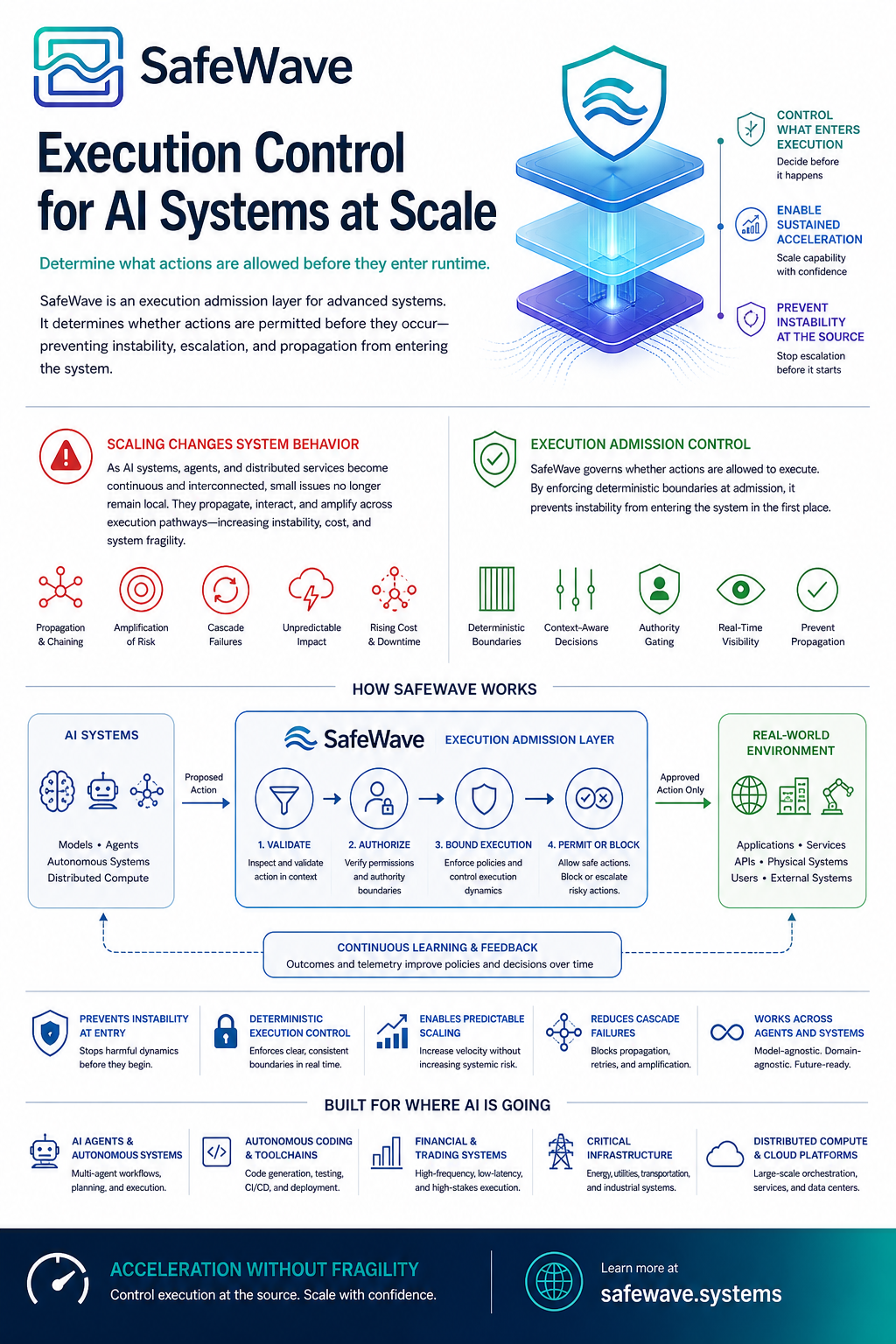
SafeWave provides execution-control infrastructure for keeping advanced AI and automated systems bounded, predictable, and resilient as they become more capable, connected, and autonomous.
As AI systems gain the ability to act across software, services, networks, machines, and real-world environments, failures no longer stay local.
An unstable retry loop, excessive authority grant, compromised workflow, poorly bounded agent, or unsafe automated action can propagate faster than ordinary human review can catch.
SafeWave is designed to enforce boundaries before execution expands, persists, consumes resources, influences humans, or reaches high-consequence environments.
This does not mean slowing AI down. It means enabling safer acceleration: higher capability with stronger execution boundaries underneath it.
For high-risk systems, those boundaries cannot remain only in policy documents, dashboards, or user settings. They need to be enforced through software, runtime environments, firmware, and eventually silicon where needed.
SafeWave as a modular execution-boundary architecture
SafeWave is not a single guardrail. It is a modular architecture of runtime protocols and enforcement substrates that can be applied according to a system’s risk, autonomy, and operating environment.
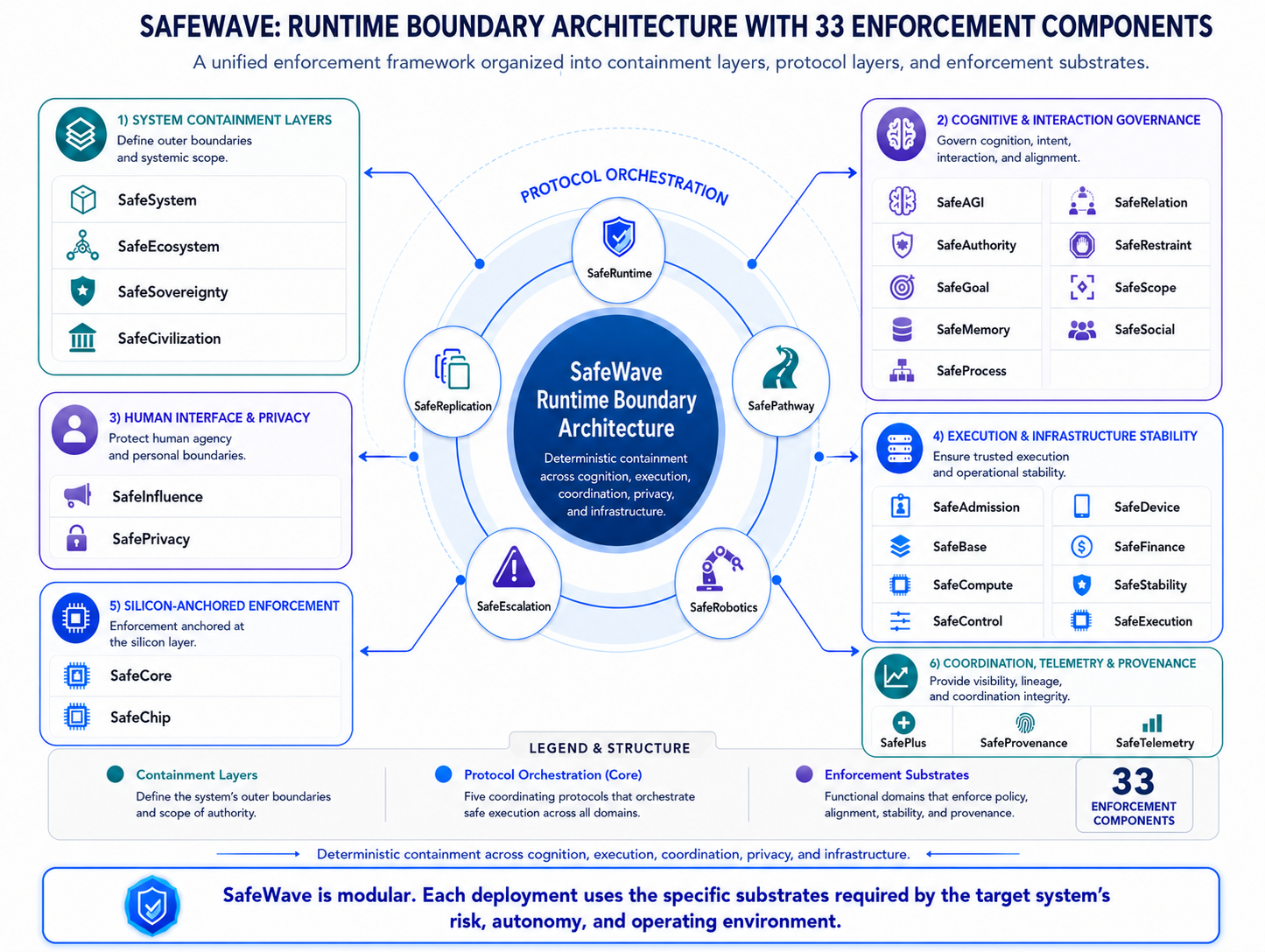
Click image to open full-size architecture diagram.
SafeWave helps organizations identify and enforce execution boundaries before autonomy, authority, propagation, or consequence exceed control.
AI systems are engineered to scale capability rapidly.
But as execution velocity increases, instability can scale with it.
SafeWave enables sustained acceleration by controlling execution admission before actions are allowed to occur.
SafeWave is an execution-boundary architecture governing execution participation, authority boundaries, propagation, memory, resource demand, system coordination, and human interaction across autonomous and large-scale systems.
Where SafeWave sits in the stack
models • agents • robotics • distributed compute
pre-execution validation • authority gating • escalation prevention • coordination stability
nodes • orchestration • firmware / silicon anchors
SafeWave determines whether execution is permitted before it enters runtime. It is not a security, isolation, or virtualization layer — it is a deterministic admission control system for autonomous execution.
As AI moves from screens into robots, boundaries must move with it.
Control cannot remain only in prompts, policies, cloud monitoring, or model behavior. Physical AI systems need enforceable execution boundaries around motion, force, access, tools, rooms, humans, escalation, and shutdown.
As autonomous systems scale, a new class of infrastructure risk emerges: escalation dynamics. Distributed agents, machine-speed services, and tightly coupled automation environments can generate amplification patterns such as retry storms, coordination cascades, and cross-system propagation loops.
Traditional cybersecurity protects systems from external threats. SafeWave governs whether internal system actions are allowed to execute in the first place.
Explore escalation stability in the age of autonomous systems →
AI capability is accelerating across hyperscale compute, cloud platforms, robotics fleets, financial systems, defense infrastructure, industrial environments, and energy-coupled data centers. Deployment cycles are compressing. Systems are increasingly interconnected. State persists across sessions. Coordination is becoming continuous.
What limits acceleration in these environments is no longer only intelligence. It is whether execution boundaries remain enforceable as capability, autonomy, integration, and speed increase.
Scaling Changes Failure Dynamics
As execution velocity increases, authority expands across APIs, services, and physical interfaces. Systems retry aggressively under load. Agents delegate tasks across toolchains. Distributed nodes synchronize continuously under uncertainty.
In this regime, failure behaves differently than it did in traditional software environments.
A mis-scoped permission can propagate across integrated services before review cycles detect it. An unstable retry loop can saturate compute clusters and trigger cascading degradation. A synchronization fault across distributed nodes can amplify disruption rather than isolate it. A poorly bounded update can compound through dependent systems instead of self-correcting.
In tightly coupled, high-speed environments, instability does not remain local. It spreads through shared execution pathways — unless execution itself is gated before it occurs.
This is not primarily a policy failure. It is an execution control failure. When execution occurs faster than review, control must operate before execution — not after.
When execution becomes the control surface
SafeWave addresses this constraint at the execution admission boundary.
Rather than interpreting model content or imposing post-execution controls, SafeWave determines whether actions are allowed to occur at all. It gates authority expansion, prevents unstable retry dynamics from initiating, blocks cascading coordination effects before propagation, and ensures only bounded execution enters the system.
This enforcement is implemented through structural substrates governing execution admission, coordination dynamics, authority expansion, and system interaction.
The result is not reduced autonomy. It is bounded autonomy.
When execution is structurally governed at admission, organizations can increase velocity without increasing systemic exposure. Engineering teams spend less time reacting to cascades. Deployment confidence rises. Energy waste declines. Liability becomes more manageable. Acceleration becomes economically sustainable.
This pattern is not unique to AI — it emerges in all sufficiently complex systems. Power grids required circuit breakers before they could scale reliably. Financial markets required clearing mechanisms before high-velocity trading became stable. Aviation required pre-flight validation systems before global commercial flight became routine.
At sufficient speed and complexity, execution must be controlled before it occurs. AI systems are now reaching that threshold — and other complex systems are close behind.
What SafeWave does
SafeWave integrates beneath applications and models, embedding enforceable boundary controls around execution, authority, propagation, memory, resource demand, and system behavior — with the option to anchor deeper into firmware or silicon where higher assurance is required.
SafeWave does not monitor or contain behavior after execution. It determines whether execution is allowed to occur in the first place.
This is sustained acceleration: expanding capability while preventing instability from entering the system.
How SafeWave is adopted
SafeWave is modular and assessment-driven.
Each deployment begins with a system-level analysis to determine where execution dynamics introduce amplification risk. Structural admission control is applied precisely, aligned to the architecture and risk profile of the system in question.
Over time, SafeWave control boundaries can increasingly anchor at firmware and silicon layers, where execution permission becomes intrinsic rather than enforced externally.
SafeWave System Risk & Acceleration Assessment
Identify where execution dynamics may limit scale across your systems — and how pre-execution control can unlock durable velocity.
Contact
If you’re interested in learning more or exploring a conversation, reach out:
SafeWave Systems
ron@safewave.systems