Post-Breach Execution Containment for AI-Enabled Systems
As AI cyber risk moves toward machine speed, organizations need a missing layer: deterministic limits on what compromised systems can execute after penetration.
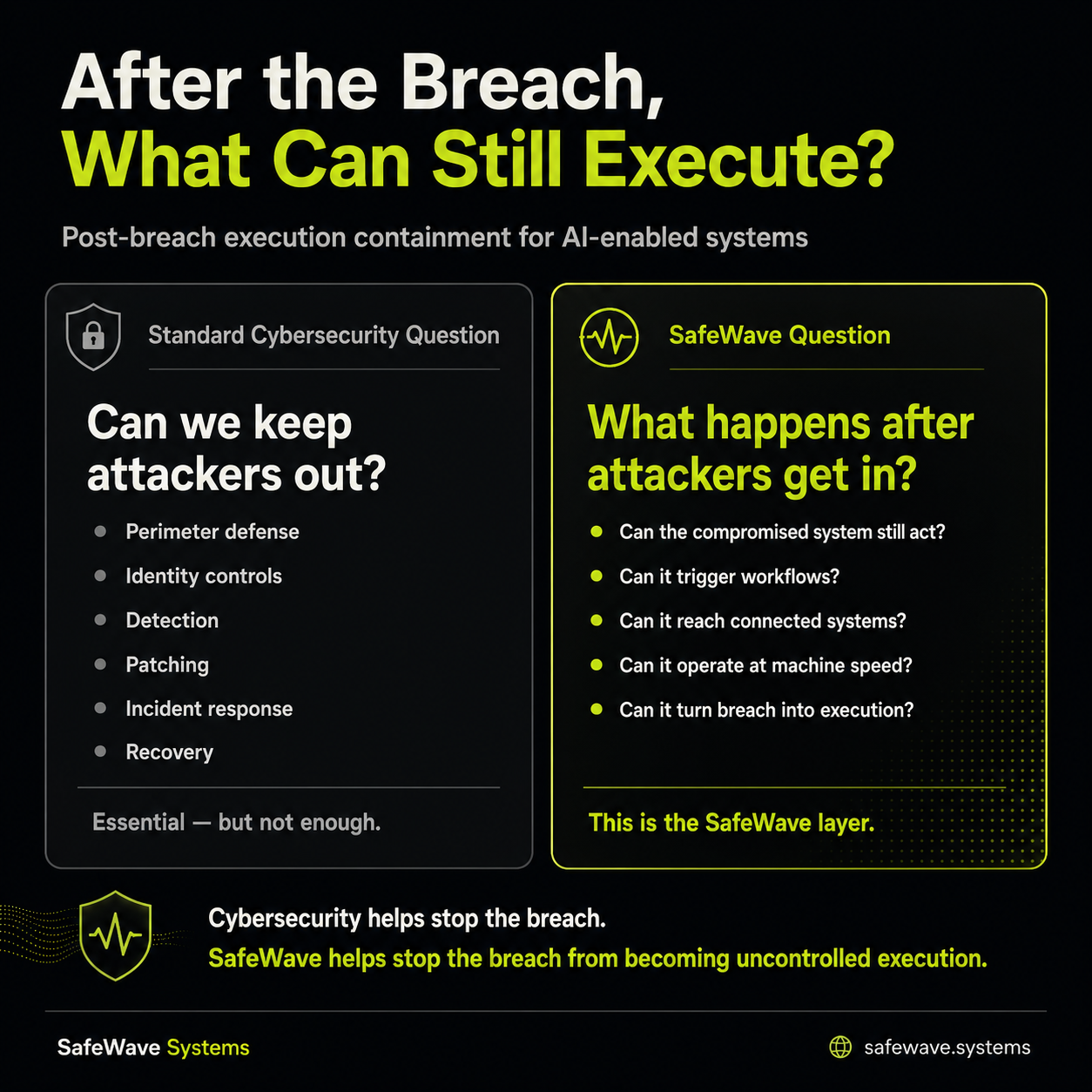
Recent warnings from national cyber agencies make one point difficult to ignore: artificial intelligence is changing the speed, scale, and complexity of cyber risk. Frontier AI systems can help defenders discover and repair vulnerabilities, but similar capability can also compress the time available to attackers, defenders, and decision-makers.
That changes the cybersecurity question.
It is no longer enough to ask, “Can we keep attackers out?” Leaders must also ask, “What is a compromised AI-enabled system still allowed to execute after penetration?”
The cybersecurity perimeter is necessary, but no longer sufficient
Cybersecurity fundamentals remain essential. Organizations still need strong identity controls, reduced attack surfaces, asset inventory, vulnerability management, patching, monitoring, backups, incident response, and supply-chain discipline.
But AI-enabled attacks create a second-order problem. If a system is penetrated, credentials are abused, an AI agent is compromised, or a trusted workflow is manipulated, the decisive risk may become execution itself: what the compromised environment can run, trigger, escalate, retry, replicate, or propagate before humans can respond.
The missing layer: post-breach execution containment
SafeWave defines this missing layer as post-breach execution containment.
The purpose is not to replace cybersecurity. The purpose is to complement cybersecurity with deterministic runtime boundaries that limit what AI-enabled systems can do when ordinary protections fail, trusted pathways are abused, or compromise moves faster than human response.
In practical terms, this means focusing on the execution behavior of:
- AI agents and agentic workflows
- enterprise automation systems
- devices and edge systems
- compute environments and retry loops
- robotics and autonomous fleets
- connected infrastructure and high-consequence operational systems
Why this matters now
AI-native cyber defense is accelerating. Model providers and security organizations are already using frontier AI to find vulnerabilities, assist remediation, support defensive workflows, and improve software security. That work is valuable and necessary.
But faster discovery and faster patching do not eliminate the need for containment. Organizations must assume that some vulnerabilities will be found too late, some patches will lag, some credentials will be abused, some workflows will be misused, and some AI-enabled systems will be compromised.
When that happens, the question becomes operational:
What is the compromised system still allowed to execute next?
Where SafeWave fits
SafeWave is implementation-ready execution-boundary infrastructure for AI-enabled systems.
Its cybersecurity value is direct: when a breach occurs, SafeWave is designed to sharply limit what compromised AI agents, devices, workflows, compute environments, robotics, and connected infrastructure can execute next.
SafeWave focuses on boundaries around execution authority, propagation depth, retry velocity, replication behavior, escalation pathways, recovery logic, and evidence signals. These are not substitutes for cybersecurity controls. They are runtime containment controls for the moment when cybersecurity boundaries are penetrated or trusted systems are abused.
The simple distinction
Cybersecurity helps stop the breach.
SafeWave helps stop the breach from becoming uncontrolled execution.
That distinction matters because AI-enabled systems are moving beyond chat interfaces into agents, devices, infrastructure, compute environments, robotics, and enterprise workflows. As execution becomes more autonomous, containment must become more architectural.
Strategic briefing
SafeWave is seeking qualified strategic conversations with leaders working at the intersection of AI cyber defense, frontier AI deployment, critical infrastructure, enterprise systems, robotics, compute environments, and runtime containment.
For a private briefing, contact SafeWave Systems at ron@safewave.systems.